



Every startup funding decision involves a trade. You give up something to get capital: interest payments, a share of revenue, a slice of ownership, a seat at the table or simply your own savings and peace of mind. Founders often focus on how much money they can raise, when the more important question is what that money will cost and how much control it will take away.
The infographic below ranks eight common funding options along two dimensions. The first is control, meaning how much decision-making power and ownership you keep. The second is cost, meaning what you pay for the money, whether in interest, fees, equity or obligations. The options run roughly from the most founder-friendly to those that involve the biggest trade-offs, and the sections below explain each in practical terms.
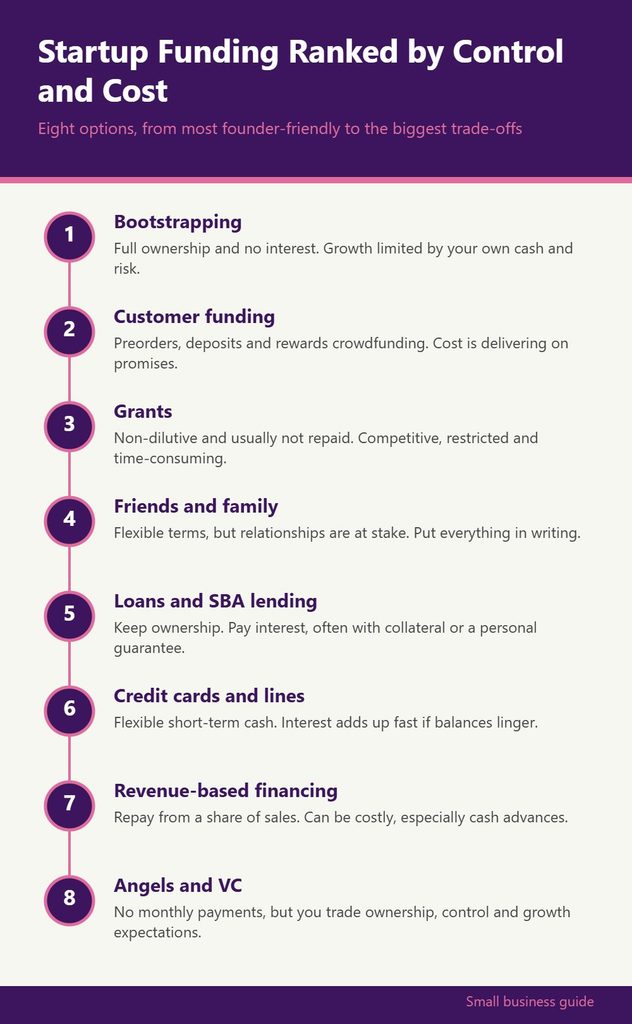
1. Bootstrapping: Full Control, Personal Cost
Bootstrapping means funding the business from your own savings and, crucially, from the revenue the business generates. You keep 100 percent ownership and answer to no one except your customers. There is no interest, no investor reporting and no pressure to grow faster than makes sense.
The cost is personal. Growth is limited by your cash, and you carry all the financial risk. Many founders keep a day job or freelance on the side while the business gets off the ground. Bootstrapping works particularly well for service businesses, software products with low upfront costs and companies that can charge customers before delivering, such as through deposits or subscriptions.
Watch out for: draining your emergency fund or retirement savings without a clear limit. Decide in advance how much you are willing to risk.
2. Customer and Revenue-Based Funding
Your customers can be an excellent source of capital. Preorders, deposits, annual prepaid subscriptions and retainers all bring money in before you spend it. Crowdfunding platforms that use a rewards model, where backers receive a product rather than equity, fall into this category too.
Control stays almost entirely with you, and the cost is the obligation to deliver what you promised. Customer funding also validates demand, which is useful evidence if you later approach lenders or investors. The risk is overpromising: if production delays or cost overruns prevent you from fulfilling orders, you damage trust and may face refund demands.
3. Grants and Competitions
Grants are non-dilutive and usually do not need to be repaid, which makes them some of the cheapest capital available. Sources include federal programs such as the Small Business Innovation Research (SBIR) program for research-focused companies, state and local economic development agencies, nonprofit foundations and corporate grant programs. Pitch competitions and accelerator prizes can also provide cash without taking equity.
The cost is time and restrictions. Applications can be lengthy and competitive, funds are often limited to specific uses, and reporting requirements may follow. Grants rarely cover a startup’s full needs, so treat them as a valuable supplement rather than a primary strategy. Be wary of anyone charging upfront fees to “guarantee” a grant.
GrowBizLab covers grants and how small businesses can find legitimate opportunities, along with eligibility tips and application advice. If grants could fit your situation, check it out before you spend hours on applications that are not a good match.
4. Friends and Family
Many startups raise their first outside money from people who know the founder. It can be structured as a gift, a loan or an equity investment. The terms are often more flexible than anything a bank or professional investor would offer.
The hidden cost is relational. Losing a stranger’s money is uncomfortable; losing your aunt’s retirement savings can strain family relationships for years. Protect everyone by putting the arrangement in writing, being clear about the risk of total loss, and choosing a structure deliberately. A promissory note with a repayment schedule is very different from an equity stake, and each has tax and legal implications. A lawyer can help you set it up properly, and securities rules may apply if you sell equity.
5. Small Business Loans and SBA-Backed Lending
Debt lets you keep full ownership. Once the loan is repaid, the lender has no further claim on your business. Options include bank term loans, SBA-guaranteed loans, microloans from community lenders and credit unions, and equipment financing secured by the asset being purchased.
The cost is interest and fees, plus the obligation to make payments regardless of how the business performs. Lenders typically look at credit history, cash flow, collateral and time in business, which can make it hard for very new startups to qualify. Many require a personal guarantee, meaning you are personally responsible if the business cannot repay.
SBA-backed loans can offer longer terms and more accessible requirements than conventional loans because the government guarantees a portion of the lender’s risk. Microloan programs often focus on newer and underserved businesses and may include business coaching.
6. Business Credit Cards and Lines of Credit
Credit cards and lines of credit provide flexible, revolving access to cash. They are useful for smoothing out uneven cash flow, covering short-term inventory purchases or handling unexpected expenses. You keep full control, and you only pay interest on what you use.
The cost can climb quickly. Credit card interest rates are typically much higher than term loans, and carrying a large balance for months can become expensive. Introductory zero-percent offers can help if you have a clear plan to repay before the promotion ends. Used responsibly, business credit products also help build a business credit profile that makes future borrowing easier. For a deeper look at building business credit and comparing products, you can get more details in the GrowBizLab finance section.
7. Revenue-Based Financing and Merchant Cash Advances
Revenue-based financing provides capital in exchange for a percentage of future revenue until a set amount has been repaid. Payments rise and fall with sales, which can be easier to manage than fixed loan payments. You do not give up equity.
Merchant cash advances work similarly but are tied to card sales and are often among the most expensive forms of financing. Because they are frequently structured as purchases of future receivables rather than loans, the effective cost can be hard to compare with traditional interest rates. Calculate the total amount you will repay and how quickly, then compare that to other options. These products can make sense for businesses with strong recurring revenue that need fast capital, but they can trap businesses with thin margins.
8. Angel Investors and Venture Capital
Equity investors provide capital in exchange for ownership. Angel investors are typically individuals investing their own money, often at early stages. Venture capital firms invest larger amounts from pooled funds and usually target companies with the potential for very rapid growth. Equity crowdfunding platforms allow startups to raise smaller amounts from many investors under specific regulations.
Equity has no monthly payment, but it is often the most expensive capital in the long run if the business succeeds, because investors share in the upside forever. It also comes with the biggest loss of control. Investors may receive board seats, voting rights, approval rights over major decisions and expectations about growth and an eventual exit. Venture capital in particular suits only a small fraction of businesses: those aiming for very large markets and willing to pursue aggressive growth.
Before taking equity, understand dilution, valuation, liquidation preferences and the terms in any convertible note or SAFE. An experienced startup lawyer is worth the fee here.
How to Read the Rankings
The order in the infographic is a general guide, not a rule. The real cost of any option depends on your circumstances. A low-interest SBA loan may be cheaper than equity in a fast-growing company, but expensive and risky for a business with unpredictable revenue. A friends-and-family investment may carry no interest but could cost you something more valuable.
When comparing options, ask four questions:
- What will I pay in total? Include interest, fees, revenue share or the future value of equity.
- What control do I give up? Consider ownership, voting rights, reporting obligations and personal guarantees.
- What happens if things go badly? Debt must be repaid regardless; equity investors share the loss.
- Does this match my growth plan? Some capital expects rapid scaling; some fits steady, profitable growth.
Common Funding Mistakes
- Raising before you need to. Capital raised too early often comes on worse terms, because there is less proof that the business works. A few more months of traction can change the conversation entirely.
- Comparing only headline rates. A loan with a low rate and heavy fees can cost more than one with a slightly higher rate and none. Always compare the total repayment amount.
- Signing personal guarantees casually. A guarantee puts your personal assets on the line. Understand exactly what you are agreeing to.
- Giving away too much equity early. Selling a large stake in the first round can leave little room for future rounds and may discourage later investors.
- Ignoring the paperwork. Informal arrangements, especially with friends and family, create disputes later. Clear documents protect both sides.
- Using short-term money for long-term needs. Funding a multi-year equipment purchase with an expensive cash advance is a mismatch that can strain cash flow for months.
Combining Sources
Most startups use more than one source over time. A common path is bootstrapping and customer revenue at the start, adding a grant or microloan to fund a specific need, then using a line of credit to manage cash flow as revenue grows. Some businesses never need outside equity at all. Others raise an angel round once they have evidence of traction.
The best funding strategy is the one that gets you the capital you need at a cost you can afford, while keeping enough control to build the company you set out to build. Start with the options that preserve the most control, move down the list only when the opportunity justifies it, and get professional advice before signing anything that commits you or your business for years.
