


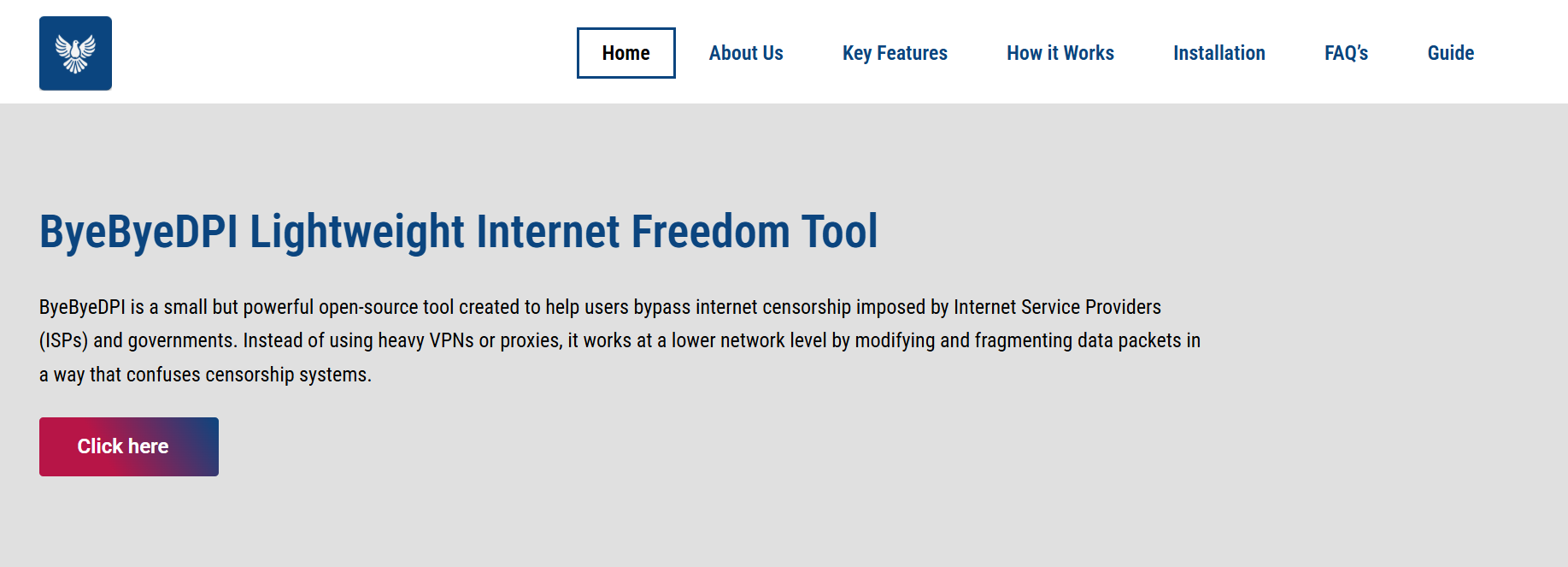
Browsing privacy has become a major concern as internet service providers (ISPs), governments, and even some networks use advanced monitoring systems like Deep Packet Inspection (DPI) to analyze user traffic. Tools such as byebyedpi have gained attention because they aim to reduce tracking and improve access to restricted content without relying on traditional VPN services. But the key question remains: can ByeByeDPI actually boost browsing privacy, and to what extent?
What Is ByeByeDPI?
ByeByeDPI is a lightweight tool designed to interfere with DPI-based censorship systems. Instead of routing traffic through external servers like a VPN, it modifies network packets locally on the user’s device.
Key Idea
- It does not hide your IP like a VPN
- It does not create an encrypted tunnel
- It alters how traffic looks to DPI systems
This makes it harder for censorship systems to reliably detect blocked domains or filtered traffic patterns.
How DPI Affects Browsing Privacy
Deep Packet Inspection (DPI) works by analyzing internet traffic beyond basic metadata. According to cybersecurity research, DPI systems can inspect:
- Website domains you visit
- Application traffic patterns
- Protocol types
- Sometimes even unencrypted content
Privacy Impact of DPI (Data Overview)
- Around 60–70% of restrictive networks globally use some form of DPI-based filtering (industry estimates)
- ISPs using DPI can classify traffic in milliseconds
- Unencrypted HTTP traffic can be fully readable by intermediaries
This means users often lose partial privacy even when browsing normal websites.
How ByeByeDPI Tries to Improve Privacy
ByeByeDPI does not directly encrypt data. Instead, it focuses on obfuscation techniques.
1. Packet Manipulation
It modifies packet structure so DPI systems struggle to correctly classify traffic.
2. Local Processing
Since it runs on-device:
- No external server logs are involved
- No third-party VPN provider is required
3. Evasion of Detection
It helps bypass signature-based blocking systems that rely on pattern recognition.
Does ByeByeDPI Truly Increase Privacy?
Advantages
- Reduces ISP-level content filtering visibility
- Avoids reliance on external VPN servers
- Lightweight and fast compared to tunneling tools
- No account registration required
Limitations
- It does NOT provide full encryption like HTTPS or VPNs
- Your ISP can still see that you are connected to certain services
- It does not hide your IP address
- Advanced DPI systems may still detect traffic patterns over time
Privacy Comparison (Simplified Data View)
| Feature | ByeByeDPI | VPN | Tor Browser |
|---|---|---|---|
| Encrypts traffic | ❌ | ✅ | ✅ |
| Hides IP address | ❌ | ✅ | ✅ |
| Bypasses DPI | ✅ (partial) | ✅ | ✅ |
| Speed impact | Low | Medium | High |
| Full anonymity | ❌ | Partial | High |
This shows that ByeByeDPI improves access privacy, but not full anonymity privacy.
When ByeByeDPI Is Useful
ByeByeDPI is most effective in situations like:
- Networks that block websites using DPI rules
- Schools or offices using filtering systems
- Regions with moderate censorship
However, for sensitive activities like:
- Financial transactions
- Private communications
- Identity protection
A VPN or Tor is still more suitable.
Security and Privacy Risks
Even though ByeByeDPI is useful, users should be aware of risks:
- It does not protect against malware or tracking cookies
- HTTPS websites are still required for secure communication
- Misuse can lead to unstable connections on some networks
Conclusion
byebyedpi can improve browsing privacy in a limited but practical way, mainly by reducing the effectiveness of DPI-based censorship systems. However, it should not be considered a full privacy solution. It works best as a complementary tool, not a replacement for VPNs or encrypted browsing technologies.
In short:
- Good for bypassing restrictions
- Not enough for full privacy protection
- Best used with secure browsing practices like HTTPS and trusted networks
